
Everything You Need to Know about Applying for Danish Citizenship (Updated for 2026)
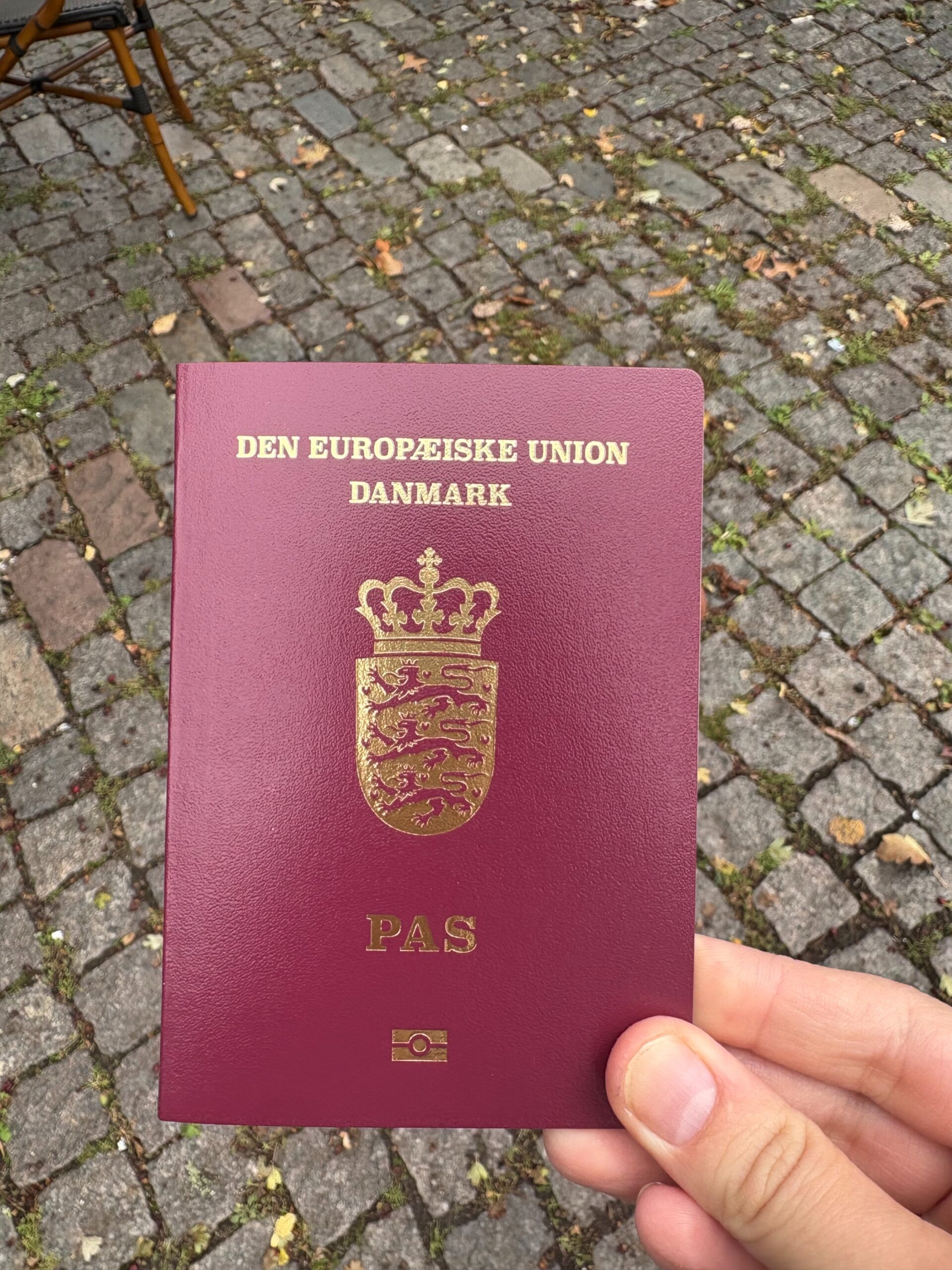
Thinking you might want to truly become a Dane one day? My first piece of advice: have patience. I took the citizenship exam in November of 2022, and I first brought home my Danish passport in October of 2025. Undeterred? Then read on to learn about the requirements and process for Danish citizenship.
The most updated requirements from UIM can always be found here, so please reference that first in case there are changes that I haven’t included here (you can always see the last date this blog post was updated at the top). I have also not included any information about special rules that cover Nordic citizens, foreign citizens who grew up in Denmark, etc., so be sure to check the requirements for your specific situation. Also check out my Resources page for other resources I suggest when applying for Danish citizenship.
If you want the short version, you can jump directly to the FAQ section at the end of this page.
What are the requirements for Danish citizenship?
To start off, here is a basic overview of the key requirements you must fill in order to be eligible for Danish citizenship:
- Have had uninterrupted residence in Denmark for 9 years
- Have had permanent residence for 2 years
- You have not committed certain crimes. Part of this requirement is that if you receive a traffic fine for 3000kr or above, you must wait 4.5 years before you can become a Danish citizen.
- You cannot have public debt
- You need to have been employed for 3.5 out of the past 4 years, working at least 30 hours per week.
- You need to have passed a Danish language exam
- You need to pass the Danish citizenship exam.
There’s a lot here that could be covered, but I will focus on the few requirements that can be particularly tricky, or at least were for me: 9 years of residence, the citizenship exam, and the employment requirement. Finally, I outline the application process and my own personal timeline for receiving citizenship.
How long do you need to live in Denmark to become a citizen?
It sounds simple enough that you need to have residence in Denmark for 9 years, but if you, like me, have traveled a lot outside of Denmark, then this one becomes a little complicated. The reason is that you can have a maximum of 1 year (365 days) of “opholdsafbrydelser,” and there are a complicated set of rules about which trips count. You can read the full details here, but it basically boils down to these three categories:
- All trips of more than 4 weeks must be reported
- All trips in any year where you have traveled more than 6 weeks out of the country must be reported
- All trips in any year where you have traveled out of Denmark more than 10 times must be reported.
I think for me this ended up something about 35 trips that I needed to report. I can recommend using an excel sheet to record them and count the number of days, and then you can transfer this over to the application when you get to that. In order to find the dates for my trips, I used my photos, as that was the easiest way. Also check any stamps in your passport, as if you, like me, have applied for residence permits in the past, they will have access to those stamps and could know if you miss something or report incorrectly. Based on my research, however, outside of passport stamps, although they can in theory access information connected to your passport about when you have traveled, it is not a regular thing that they do. So just do your best with the dates, but if you can’t find the information, it seems highly unlikely that UIM would be able to (or even try).
What is the Danish Citizenship Exam (Indfødsretsprøven) like?
The citizenship exam is made up of 45 questions, where 35 are from the reading material provided, 5 are based on current events, and 5 are about Danish culture. You need to get 36 out of 45 questions right to pass the exam, including 4 out of 5 culture questions.
How to study: I can really recommend the site nearlydanish.com to practice for the exam. If you do nothing else, use this site. There is also a Facebook group run by the same guy, which you can find here. I read through the material a few times (it is extremely long and of course in Danish, so don’t underestimate how long this might take), and practiced the questions on the Nearly Danish website (which come from previous exams). In the end, it’s a bit of luck of the draw which questions appear on your exam and whether you remember those specific facts from what you read, but you can definitely get a long way with just the database of previous exam questions. The website also covers current events, which will probably get you most of the way on those questions, but it can also be a good idea to pay a bit of attention to the news in the months before you take the exam.
For the cultural questions, they will generally be pretty easy and straightforward, and there’s not really a way to study them anyway. As bad as it sounds, if I was ever in doubt, I just thought about how would a racist person expect someone from the Middle East to answer this question and then the answer is the opposite. Maybe it sounds extreme, but introducing these questions is definitely to target people of certain backgrounds (as are virtually all immigration and foreigner-focused laws) so, for me, it worked to have that in mind.
As a general strategy, I recommend condensing your study period, if you have the time (so rather study intensely for a short period than little by little over a long period), as there are so many names, years, titles, etc. to remember, that at least I needed to have read about it close to the exam in order to actually recall it if asked.
I passed the exam with 44/45 questions right, so these methods worked well for me. Just for fun, I went to Nearly Danish to try the most recent exam while writing this and got 39/45, so I guess I can still be Danish (and I do still remember some of the things I studied).
What are the employment requirements for Danish citizenship?
One part of this requirement is that you need to be actively employed at the point in time where the law with your name is first brought forward to parliament. Generally this is either in April or in October.
The second part of this requirement is that you need to be employed for 3.5 out of the last 4 years working minimum 30 hours per week (120 hours per month). This is, in theory, quite straightforward, but if you have had parental leave, changed jobs, are self-employed, etc., it can be more tricky. A few things I have learned on this topic along the way:
- Parental leave is considered employment if it occurs while you are under an employment contract. Meaning you are employed during the entirety of your leave and you return to the same employer after your leave ends. This was key for me as I was thinking of changing jobs, but I needed to return to my old job first.
- Employment is about the hours worked – “garden leave” or similar, where you are paid but not working, technically does not count. (I am not sure if they have a way to know that you are not working if you are being paid, but if they were to find out, it would not count. I did check my lønseddel from the month I was paid but not working, and it does list my regular hours, so I would guess you can probably slip by on this one.) Similarly, if you are not working due to a non compete clause (as is my case), this is also considered unemployment. For me, this meant that I technically could not change job until the law with my name on it came into effect, because I have ended up with 7 months without working between jobs, while the limit is 6 months within the last 4 years.
- This requirement must be fulfilled until the law with your name on it comes into effect. For me, my name was on the “April list”, which was voted on for the 3rd time in June (if you aren’t aware of how lawmaking works in Denmark, each law is brought up 3 times before it is finally effective), and officially came into effect on the 1st of July. After this point, I was then free to change jobs.
What is the application process for Danish citizenship?
Here I will outline all the steps in the process for achieving Danish citizenship and how long it took me to progress through each one.
Danish Citizenship Timeline: How Long Does It Really Take?

Above I have shown my personal timeline from moving to Denmark to having my Danish passport in hand. From the citizenship exam to becoming a citizen took me close to 3 years.
Note for March 2026: All citizenship applications have been paused until after the Danish parliamentary elections. The pause, election and policies of the subsequent government may have an effect on application processing times.
When should you take the Danish citizenship exam?
Before applying, you need to have all requirements in place. For most people, the final part will be the citizenship exam (and maybe the danish exam if you hadn’t done that earlier in your stay in Denmark). These exams are usually offered twice a year, in May and November. You will need to have the physical certificates that you have passed these exams so you can upload them to the application system (because yes, even though everything in Denmark can be done digitally now, in relation to all things related to foreigners, apparently systems can’t talk to each other and they make it as hard as possible).
Danish Citizenship Application
You will then need to fill out the application and pay the fee. I can recommend having your documentation on hand and your list of trips already compiled. Then you will maybe be able to fill it out in one go, but in all likelihood, it will take some time before you have everything input correctly. Once you send in your application, you should receive a receipt in your eboks within a few days that confirms your application has been received. When your application is eventually approved or rejected, you will also receive a letter in your eboks. The waiting time is extremely long so just be prepared for that. This part of the process for me was exactly 2 years.
Voting in Parliament
Once your application is approved, it will be put on the next law that will come before parliament, as in Denmark you can only become a citizen by having your name be on this law. This generally comes up twice a year, in April and October, but the list will close a few months before. I was on the April list 2025, which closed end of January 2025, and officially became law on the 1st of July 2025. If there are any special events happening, particularly if there is a national election, this schedule will be amended (or in some cases names from the current list will just be delayed until the following list).
Constitution Ceremony (Grundlovsceremoni)
The final step is to attend a constitution ceremony in the municipality where you live. Every municipality needs to hold a ceremony within 4 months of the law coming into effect. Mine was held at the end of September 2025. I assume the format for each municipality is a bit different. In mine, it was somewhat informal in that we were standing the whole time. The mayor made a speech, and then they had us get in line to show IDs, sign a paper and then shake the mayor’s hand and receive our citizenship certificate. They had some nice refreshments and a little reception after, but it was relatively short and we weren’t there more than an hour.
Officially Danish!
After you attend the ceremony, it will take some time before your status in the system is updated to reflect your new citizenship. For me, it was quite fast – I had my citizenship exam on a Tuesday and on Friday my status was already changed. On Monday I was in the Borgerservice to request my passport and that Friday I had it in my hands, approximately 10 days after the ceremony.
Frequently Asked Questions about Applying for Danish Citizenship
How long does it take to get Danish citizenship in Denmark?
The full process takes several years. You need to have lived in Denmark for 9 years before you’re even eligible to apply, and once you submit your application, the waiting time for approval is approximately 2 years. After approval, you’ll be placed on the next parliamentary list (which comes up in April or October), attend a constitution ceremony, and then receive your passport. In total, expect the process from application to passport to take around 3 years. You can see more about my own timeline above.
Does Denmark allow dual citizenship?
Yes, you can keep your exisiting citizenship(s), provided it is also allowed by the other country. My children have 3 citizenships, including Danish.
What is the Danish citizenship exam (Indfødsretsprøven)?
The Indfødsretsprøven is a multiple-choice exam consisting of 45 questions covering Danish history, society, and culture, as well as current events. You need to answer at least 36 out of 45 correctly to pass, including a minimum of 4 out of 5 cultural questions. The exam is offered twice a year, typically in May and November. You can read more about the exam and how to prepare here.
What Danish language level do you need for citizenship?
You need to have passed a Danish language exam at the Prøve i Dansk 2 (PD2) level or higher. If you’ve already completed a Danish language course through your municipality, you may already have this certificate — check your documentation before applying.
How much does it cost to apply for Danish citizenship?
You should check the current fee on the UIM website as fees are subject to change, but the current application fee is 6.270 kr. There is a lower price if you were born or mostly raised in Denmark, and there is another lower fee if it is not your first application for citizenship.