
Traveling with Twins: What I’ve Learned from Flying Around the World as a Family of Four
From strollers to sleep setups, everything that made our international trips doable (and even enjoyable).
When our twins were 9–10 months old, we took our first long-haul trip: Copenhagen to San Francisco, then San Francisco to Newark, and finally Newark back to Copenhagen — all over their first Christmas. We luckily had my sister along for the first two legs, which already brings me to my first piece of advice: bring extra hands, if you can.
A few months later, we flew Copenhagen to Barcelona when they were 14 months old — a much easier experience since it overlapped with their nap time (an excellent hack if your children can sleep on planes and your trip is short enough).
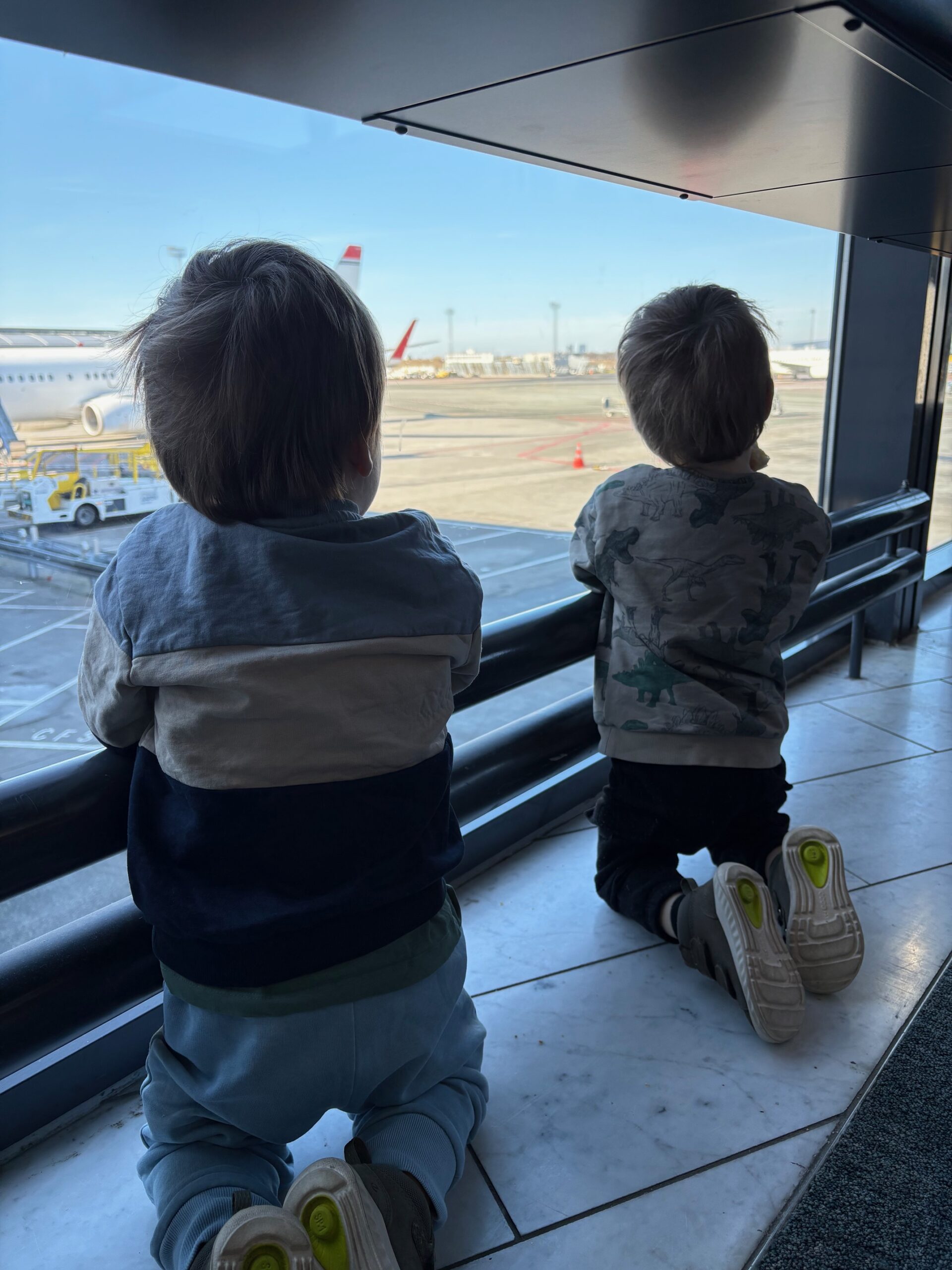
Then came our Copenhagen to Philadelphia round trip at 16 months. It was infinitely harder. They could walk, didn’t want to sit still, and were too young to be entertained by screens. Traveling with twins doesn’t necessarily get easier, but it definitely changes. Around 18 months, we found that they finally started being distractible by a screen — a tool we’ll definitely be using on our next flight! So, after multiple international trips, here’s my realistic, experience-tested guide to traveling with twins — what’s essential, what’s not, and how to stay (mostly) sane along the way. You can also find more resource suggestions on my Resources page.
Our Basic Travel Setup
We’ve learned through trial and error that this combination works best for us:
- Two travel strollers (Joolz Aer)
- Two baby carriers (Ergobaby 360 Mesh)
- Two backpacks — one as a diaper bag and one as a regular backpacking-style carry-on
- Two large hard-case rolling suitcases
- Two car seats in travel bags (that can be worn as backpacks)
Read on for my detailed suggestions for how to prepare for successful plane travel with twins.
1. The Right Stroller Setup
I’ve researched basically every travel stroller that exists and personally tried the Joolz Aer, Bugaboo Butterfly, and Stokke Yoyo. Without a doubt, the Joolz Aer is the best. If you push all three, it’s immediately clear that the Aer drives best — it’s smoother, sturdier, and more comfortable to maneuver.The Aer is also lightweight, compact, and cabin-approved, so you can take it on board the plane and use it to navigate the airport easily. The folding mechanism is effortless, it fits in the overhead compartment, and it’s stable enough to handle both city sidewalks and airport terminals.
2. Baby Carriers (Ergobaby 360 Mesh = Lifesaver)
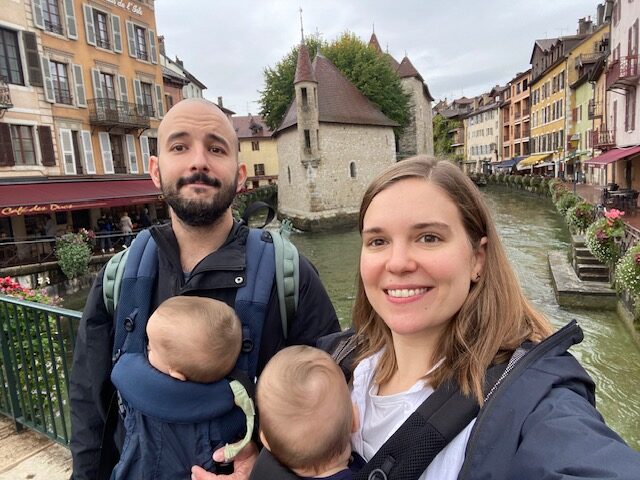
Even with great strollers, baby carriers are absolutely essential. We use the Ergobaby 360 Cool Air Mesh, which can be worn in front or back carry, and when used on the front, the baby can face either forward or backward.
We’ve found the carriers indispensable for getting all people and things onto the plane, especially when both parents need to be hands-free. They’re also incredibly helpful for helping the kids fall asleep mid-flight or during long airport waits. The mesh design keeps everyone cool, and the ergonomic support makes a huge difference over long travel days.
3. Car Seats & Transport
If you’re bringing car seats, invest in car seat travel bags that can be worn as backpacks. It’s the only way we can get everything from the curb to check-in without losing our minds.
If you’re traveling across the Atlantic, you won’t find any car seat that’s “legal” in both the U.S. and Europe — the standards differ — but I still recommend traveling with your own car seat. It’s safer, and you can’t always rely on the quality of seats provided by rental agencies. Having your own ensures that your twins are secure and comfortable wherever you go.
4. Diaper Bag & Changing Essentials
Forget the bulky traditional diaper bag — go for comfort and practicality. I love the Lululemon backpack, which comes with a removable changing insert. It’s the same one I use daily at home.
You can really use any backpack-style diaper bag or a regular backpack with a portable changing pad. Inside, I pack:
- Diapers (about one for every 1–2 hours of travel — you probably won’t use them all, but better safe than sorry)
- Wipes (plenty!)
- Diaper cream
- Diaper disposal bags
- Muslin cloths for spills or spit-ups
- Disposable bibs for mealtimes (our 15-month-olds refused to wear them, but they worked great around 9–10 months)
- Change of clothes for kids and parents (+ pajamas for kids for long haul flights)
5. Feeding Gear
Depending on your twins’ age and eating stage:
- For babies on formula: Bring ready-to-use formula bricks — no mixing or measuring required. Make sure to bring a bit more than you think you need.
- For toddlers: Pack lots of pouches and snacks. We especially love individual boxes of raisins and traditional snacky foods like pretzels or corn puffs.
- Don’t forget water bottles for everyone!
And if you’re lucky, some airlines will offer a baby meal. We once got one from American Airlines, and it was surprisingly great!
6. Compact Sleep Setup
We pack two travel cribs in one large, hard-case rolling suitcase — it keeps everything together and easy to check in. We use a style similar to the BabyBjörn Travel Crib (ours is a more affordable version) that folds small and sets up quickly.
We also bring their loveys – at least one each on the plane with us, and more in the suitcase. For the plane, it can help to use a clip to attach to the lovey to be sure it doesn’t get lost (we learned this the hard way).
We generally can pack most of the kids’ clothes in the same suitcase as the cribs. To keep everything organized, I like to use zip baggies for each outfit. That way, I just pull a bag and I have an outfit for both kids for the day.
7. Entertainment
Let’s be honest — keeping twins entertained while traveling is half the battle. These are some things that helped before ~18 months, when screens weren’t an option:
- Kids’ headphones for music or videos (we love the Senz ones with animal designs)
- Spinners are great to have on hand.
- Painter’s tape is also a great distraction. Stick it on, let them peel it off.
- Wrap small items and let them unwrap them one at a time during the trip
- Poke-a-Dot books were a big hit at 15 months
- Remember: Any random item can be a toy — cups, napkins, spoons, you name it
- And if all else fails — give them your phone. Let them look at pictures, scroll around, or tap through videos. They’ll survive (and so will you).
8. Seating & Flying Tips
A few practical things that make a huge difference:
- You cannot have two lap infants in the same row — there’s usually only one extra oxygen mask per row.
- Until age 2, we often bought one extra seat so we could have a full row and some room to move around.
- When the twins were small enough for bassinets, we didn’t need an extra seat — on SAS, for example, you can book the bassinets for free, and we even managed to get the whole row to ourselves.
Final Thoughts: What I’ve Learned Traveling with Twins
If I’ve learned one thing from traveling with twins, it’s that there’s no such thing as a perfect trip. Something will spill, someone will cry (possibly you), and you’ll probably wonder at least once why you ever thought this was a good idea. But there are also incredible moments — a baby giggling on your lap as the plane takes off, a stranger offering to help you carry a stroller, the quiet satisfaction of realizing you actually did it.
Every trip has made us more confident, more adaptable, and more willing to say yes to new adventures — even when they’re messy. So if you’re on the fence about traveling with twins: go for it. You’ll survive, your kids will thrive, and you’ll come home with memories that make all the logistics worth it.