
Our Neonatal Experience in Denmark: Life in the NICU With Premature Twins
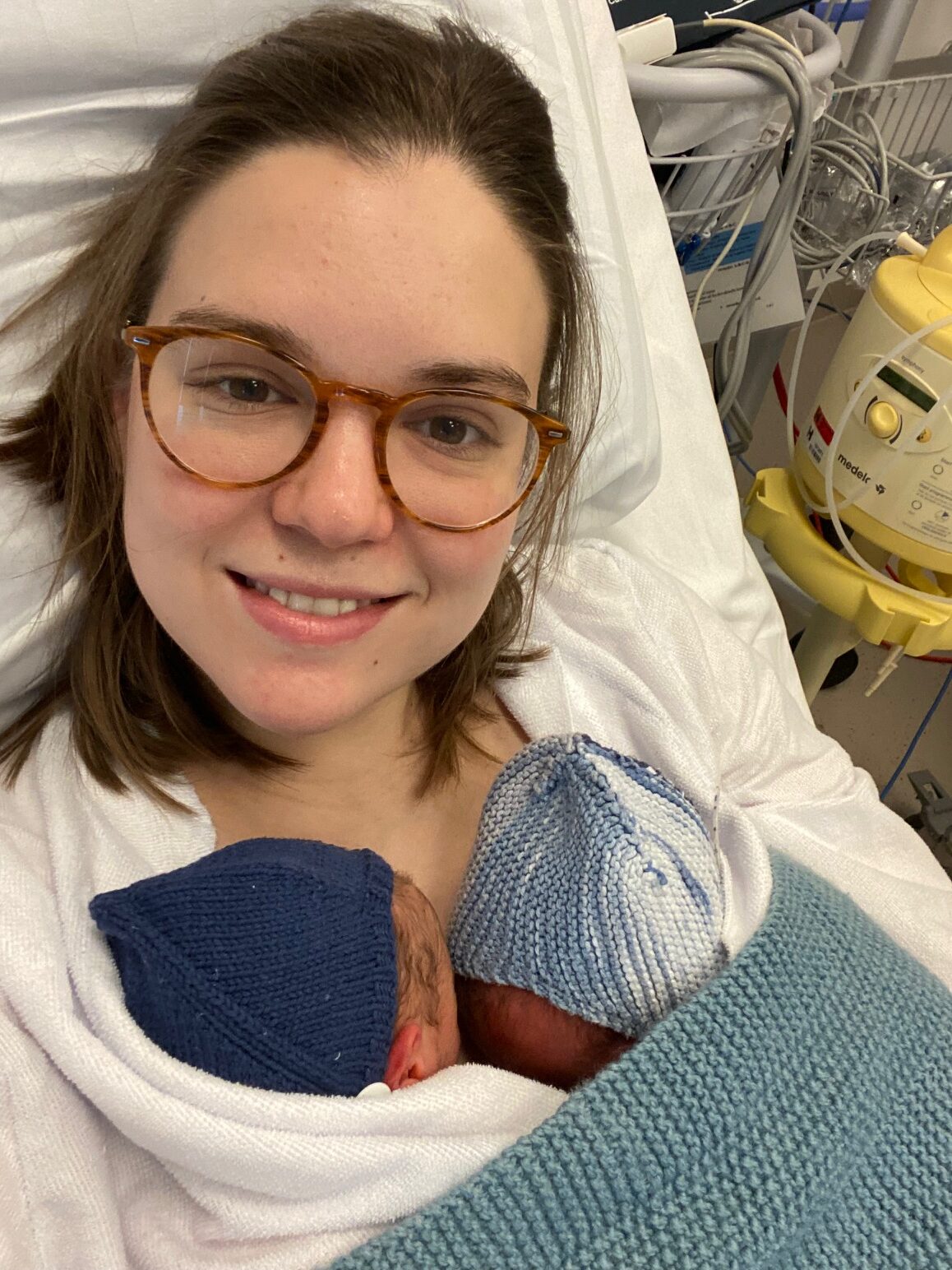
When our twins were born at 35 weeks and 4 days, we already knew there was a very good chance we would spend time in the neonatal unit. Any baby born under about 2.3 kg is typically admitted to the neonatal for monitoring, and both of our boys fell below that threshold. During the pregnancy, our Twin A had been diagnosed with severe intrauterine growth restriction (SIUGR), so we had been closely monitoring his weight for months. Before birth he was estimated to be around 1.6 kg, though he surprised us by arriving closer to 1.85 kg.
Because we knew this was coming due to Twin A’s size, one of the neonatal pediatricians met with us the morning of my C-section. She even attended the birth (read more about our birth story here), which helped us feel more prepared for what would happen next. Even so, nothing really prepares you for walking into (or being rolled into, as was my case) the neonatal unit as a brand-new parent.
Read on to find out more about our neonatal experience in Denmark.
What Happens When Babies Go to the Neonatal
In our case, the neonatal stay wasn’t about major medical complications. The boys were stable from the beginning, and our time there was mainly focused on feeding and gaining weight.
Shortly after birth, feeding tubes were placed and the babies began on a two-hour feeding schedule. At first they received donor milk while my milk supply was still coming in. The neonatal uses a formula based on each baby’s weight to determine how many milliliters they should receive per feeding, so because our twins were different sizes they weren’t getting the same amount of milk.
In the beginning the nurses handled most of the feeds, which was honestly a relief given that I had not slept the night before the C-section or the night after it. Within a few days we transitioned to doing most of the feeds ourselves, and around that same time I was pumping enough that we no longer needed donor milk. Life in the neonatal quickly settles into a rhythm built around feeding times, pumping, and trying to rest in between.
The Milestones Before Going Home
There were several things our babies needed to “graduate” from before we could leave the hospital.
1. Feeding schedules
The babies started with feeds every two hours. Eventually they progressed to three-hour schedules and longer nighttime stretches.
2. How they were fed
The process slowly moves from tube feeding toward breastfeeding. At first the babies might breastfeed briefly and then receive the rest of their feed through the tube. Eventually they must complete full feeds directly at the breast.
Before discharge, we needed 24 hours of full breastfeeding with continued weight gain.
3. Temperature regulation
At first the babies stayed in a heated bassinet, wearing only diapers under layers of blankets. As they grew stronger, the heat was gradually turned down until they could maintain their own temperature.
Once they could do that, they were also able to come off the monitoring wires.
We actually received a little “certificate” from the nurses when the boys were finally “wire-free.”
Twins Stay Together in Denmark
One thing that stood out to me about neonatal care in Denmark is how strongly the system prioritizes keeping families together.
Our twins were kept in the same bassinet, which is encouraged because research suggests twins often do better when they remain together. Even more importantly, parents stay with their babies.
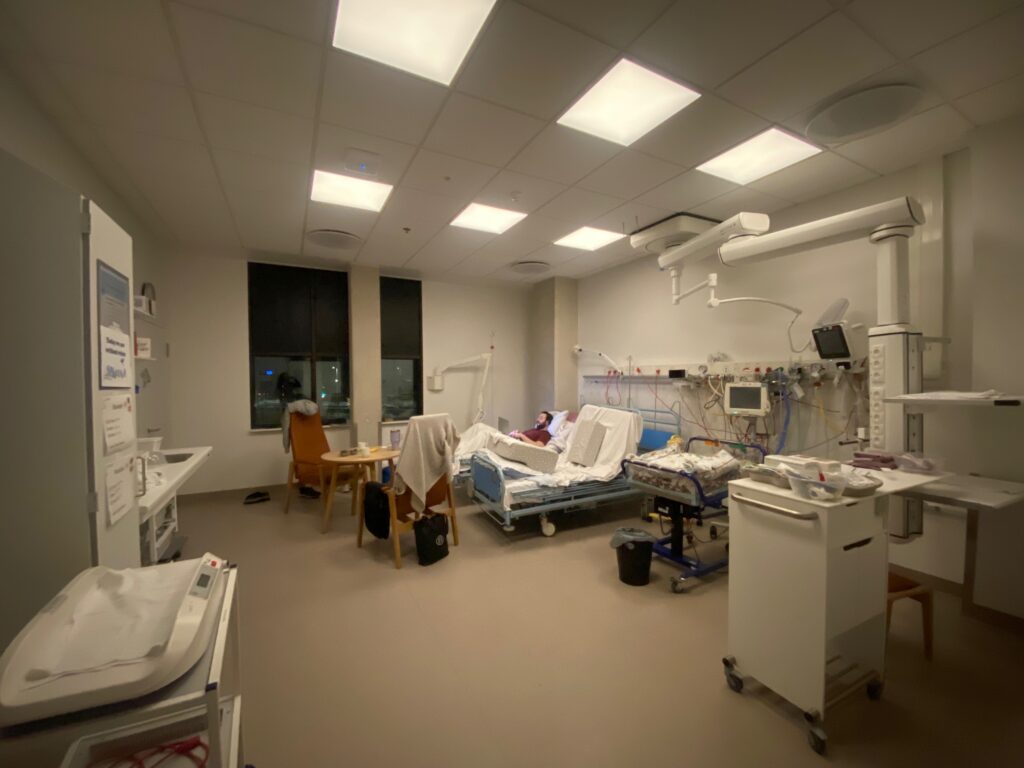
At the hospital where we were admitted, Herlev Hospital, we were fortunate enough to have a private family room (shown above) with two beds and our own bathroom. Both my husband and I could stay there with the babies the entire time. From what we later learned, Herlev is somewhat unique in offering private rooms like this, but even in other hospitals at least one parent is typically able to stay so the baby is never alone.
It’s difficult not to compare this with the United States, where many NICUs still separate parents from their babies overnight. I honestly cannot imagine being sent home without them. During our entire neonatal stay, our family was together.
The Rhythm of Neonatal Life
Life in the neonatal quickly settles into a rhythm.
Feed the babies.
Pump milk.
Try to eat/sleep/relax.
Repeat.
The nurses rotate through three shifts per day and usually introduce themselves at the start of each shift. After the first few days we didn’t need much as much hands-on help, but we still relied on them for many things due to hygiene protocols. If we needed anything—diapers, pumping parts, fresh sheets—we had to ring the call bell. That was sometimes inconvenient, but it also meant the hospital provided nearly everything we needed.
The nurses also helped us with the middle-of-the-night feeds, and were always on call to help for any doubt we had (quite the luxury as a new parent!). Meals were delivered to the unit kitchen as well. Because the babies were technically the patients, we actually ordered food under their names on the in-room ordering system. In many ways, it was full-service parenting.
And yet, it was also emotionally exhausting.
The Emotional Side of the Neonatal
Even when babies are stable, the neonatal is still a stressful place to be. You’re learning how to care for newborns while surrounded by medical professionals who do this every day. Sometimes that can feel reassuring. Other times it can feel like you’re constantly being corrected or judged. As brand-new parents of two babies, our confidence definitely took a few hits.
At the same time, the nurses were often incredibly kind. One nurse in particular checked in with us regularly during her night shifts and encouraged us to take care of ourselves too.The staff also encouraged us to leave the room for short breaks—even if it was just a walk or a quick trip to 7-Eleven between feedings. It was a long time before we got away together again from the babies once we got home.
Those small breaks mattered more than I realized at the time.
An Option to Go Home Earlier: THO
One option that exists in Denmark is THO (Tidligt Hjemmeophold), which allows families to go home earlier while still technically remaining under neonatal care. In this arrangement the baby may still have a feeding tube, and parents continue the feeding routine at home while staying connected to the hospital. A neonatal nurse visits periodically and families can still contact the unit if they need support.
To qualify for THO, babies must meet certain milestones—for example they must be able to maintain their body temperature without the heated bassinet. Once those requirements are met, some families choose to complete the final stage of feeding progress at home instead of in the hospital.
We briefly discussed doing this, but in our case it didn’t end up making sense. It was Easter week, which meant home visits would have been limited, and since the boys were already close to meeting the requirements to go home fully we decided to simply stay a few more days.
There is also a practical consideration related to parental leave. In Denmark, time spent in the hospital with a newborn patient does not count toward parental leave for up to several months. Our three weeks in the neonatal therefore didn’t reduce my leave at all. If you choose THO and go home earlier, however, your parental leave begins at that point.
Leaving the Neonatal
When the boys were finally ready to breastfeed fully, things moved faster than we expected. For weeks we had mentally prepared ourselves to stay until their due date. Instead, once they passed the final feeding milestone, everything happened quickly. Within a couple of days we were suddenly packing up and heading home—almost two weeks before their due date.
(You can also read about the recovery side of those first weeks here.)
Looking Back Now
At the time, the neonatal stay felt long and emotionally draining. But now when I look back, what I mostly feel is gratitude. Gratitude that our babies were stable, gratitude that we could stay with them the entire time, and gratitude that they could stay together.
Sometimes when I hold them now—especially our smaller twin—I still feel amazed at how well everything turned out. They are thriving, and if we had to go through the neonatal experience, I truly believe we experienced it in about the best circumstances possible.
You might also be interested in:
C-Section Experience & Recovery in Denmark
What you need for twins (Denmark edition)