
What It’s Really Like to Have a Baby in Denmark (As a Foreigner)
Before I got pregnant, I already knew the Danish health system decently well, having lived here for close to 10 years. However, navigating pregnancy in this system is a whole new ball game, with a well-defined but, at times, rigid plan for care that can sometimes leave you wondering “is this normal?” – especially if you’ve never given birth before.
Here I will try to cover at a high-level what pregnancy and birth care look like in Denmark and my advice for how to navigate it with your own and your baby’s (or babies’, as in my case) best interests in mind. If you want a detailed breakdown of my C-Section experience and recovery in Denmark, you can check out my detailed post on that topic here.
How Pregnancy Care Works in Denmark
Pregnancy care in Denmark has a specific plan, with visits with various professionals at defined weeks in your pregnany. With twins or any other elevated risk case, you will likely have more on top, but this is the baseline:
At your own doctor, you will have:
- Around week 7-9: initial visit with urine test, blood test, basic health check
- Week 25: Health check including blood pressure measurement
- Week 32: Health check including blood pressure measurement
At your birthing hospital:
- Scans
- Week 11-14: First trimester scan with nuchal translucency scan
- Week 19-22: Second trimester scan with anatomy scan
- Midwife appointments
- Week 14-20
- Week 28-29
- Week 35-36
- Week 38
- Week 40
You can read more details about the care you will receive, for example at the Herlev Hospital website (where I gave birth). You will be assigned a hospital based on where you live. If you want to change hospital, you can try to request this with your doctor, but it is not always approved. The main birthing hospitals in Copenhagen are Rigshospitalet, Herlev and Hvidovre. In the capital region, you can check your birthing hospital assignment here.
In my case, with MCDA twins, I had quite a different care plan. I had scans every 1-2 weeks, my midwife visits were earlier as I had to give birth latest at week 36+6, and I also had visits to the OB-GYN. Depending on your specific case, you may also have addition visits. I also had a gestational diabetes test around week 28 due to having a twin pregnancy.
The Role of the Midwife (Jordemoder)
Something that is quite different in Denmark to how things are done elsewhere (for example, in the US), is that your midwife generally leads most of your care. This was not necessarily true in my case, but she was still the person who we discussed most about the pregnancy with (and she was even specialized in twins). She also gave us a twin-specific birth preparation course, something I highly recommend taking advantage of if you are also expecting twins.
Generally at these appointments, you will discuss with the midwife how everything is going, share any concerns, and then she will listen for the heartbeat(s) with a monitor and feel around on your belly to estimate the baby’s size (I still don’t really understand how that last part works). In standard cases, you will also develop your birth plan together with your midwife.
Ultrasounds and Medical Monitoring
Per default you have two main scans in your pregnancy:
First Trimester Scan (Nakkefoldscanning)
This is the first scan you will have (although you can pay a private clinic for an earlier scan). It is generally around the end of your first trimester, from week 11-14. Here they will give you a risk factor for different trisomy conditions (i.e. 1 in 30,000 risk of trisomy 21), based on the measurement of the fluid in the baby’s neck combined with the results of a blood test you take in advance. If they find an elevated risk, you will be offered additional testing.
Second Trimester Scan (Anatomy Scan)
This scan is usually roughly around week 20, and here they will look at each body part of your baby to ensure it is developing correctly. If you haven’t found out previously via a blood test or private scan, here they will also be able to tell you the sex of the baby.
Birth Experience & My Experience Having Twins in Denmark
I have detailed my birth and recovery experience in this post.
I will come with a more detailed post on our 3-week Neonatal experience as well, as that is too much to add here.
Regarding a typical vaginal birth experience (or at least a birth with contractions and labor), I do not have much personal experience to add here. I do know that in general, you can contact the labor & delivery department at your birthing hospital from 20 weeks if you are ever in doubt about anything, and they will evaluate if you should come in – including once you are in labor.
I have also heard that epidurals in Denmark are different than what you would get in the US, in that I think the Danish one is called a “walking epidural” – you can still move around. I believe this is considered beneficial to keep the birth moving along. There are also many other options for pain management during birth. These will likely be presented to you at your hospital’s birth preparation course.
Another nice element of some Danish hospitals, certainly of Herlev and Hvidovre, is that they have some rooms which have additional features (the “birthing clinic” I think it is called). These are only for low risk births, but they have tubs and mood lighting and I am sure a whole host of other features I don’t remember. Certainly something to ask about if you qualify! I believe those are first come, first served.
Hospital Stay After Birth
Hospital stays in Denmark are typically quite short. You will generally get:
- One night for uncomplicated vaginal birth (first birth)
- Two nights for c-section birth
- Potentially no nights for subsequent uncomplicated vaginal births
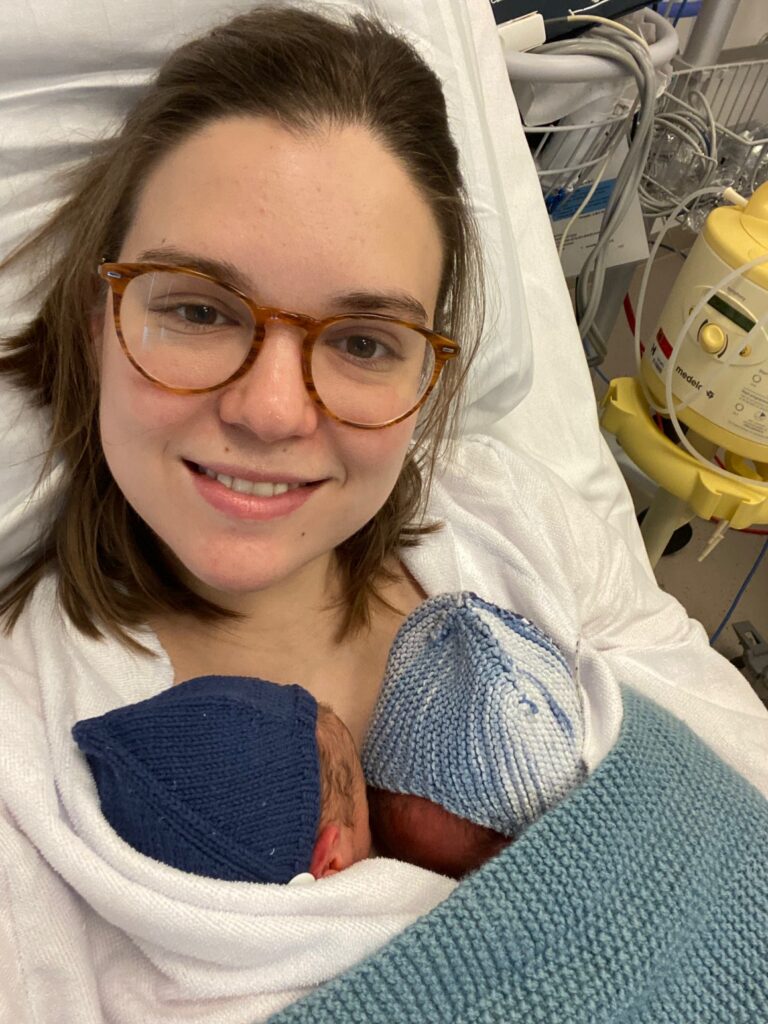
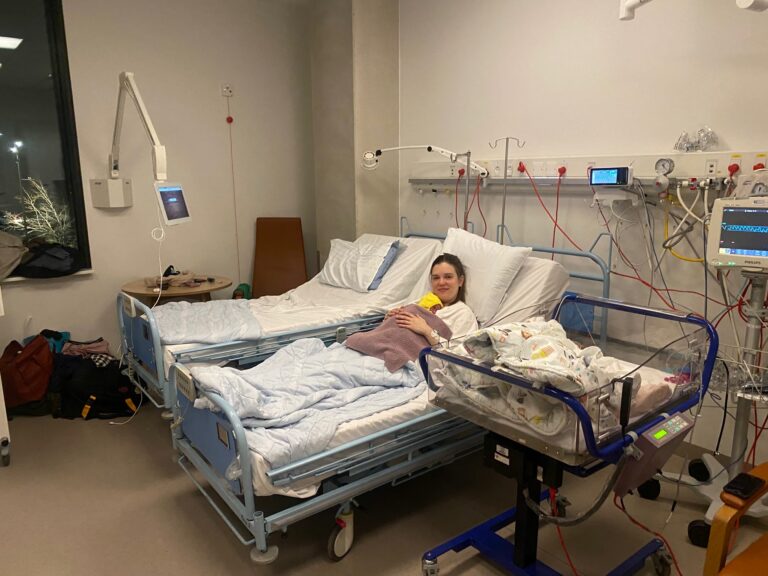
- For twins you generally get an extended stay regardless of mode of birth, around 5-7 days
Something that definitely shocked me in my first years in Denmark was finding out that many women come home from the hospital the same day they give birth. There are a lot of reasons for this, but it is certainly different than in the US because you do have home care that follows up in the subsequent days and weeks.
The Health Visitor (Sundhedsplejerske)
After you come home from the hospital, you will be connected with your home nurse (sundhedsplejerske), who will come regularly to check on you and your baby. Exactly what you are offered may depend on your mulicipality. For example, some municipalities offer a pregnancy visit prior to birth. Mine unfortunately discontinued this in the year I gave birth.
We received generally more visits than standard due to the boys’ prematurity. At these visits, she would weight them and measure their head circumference, which gets entered into an online system and then you can see charts of how they are growing relative to the WHO’s growth charts. We would spend the rest of the time discussing how things were going, the babies’ development, our parental challenges, etc.
As can maybe be expected, the frequency of these visits generally decreases as time goes on. We had many visits in the first months, starting weekly and then moving to biweekly. After the first 3-4 months, we had another visit around 5.5 months and then again at 8 months. We were then offered a visit at 18 months, which was the final one (but this is without weight measurement).
Based on our home nurse’s notes, it looks like these visits are standard:
- Initial visit
- 3-4 weeks
- 4-6 months
- 8-10 months
- 18 months
But there can certainly be variation to this.
The home nurse is also available by phone in between visits. I wrote her a few times, once to ask if a behavior was concerning and worthy of going to the doctor (luckily it was developmentally normal, so that saved us a visit) and also about their sleep and fully night weaning. Definitely a helpful resource to have!
Postpartum Recovery and Support
Postpartum care is pretty limited in Denmark, as I guess it is in many countries. Per default, what you get is an 8 week check up at your doctor. The content of this really varies. Mine was focused on mental health, which I think was important at the time, but consequently, no doctor has seen my c-section scar since the day after surgery. Others do get a more physical check. But as with everything in the Danish healthcare system, you need to ask questions and advocate for yourself if you feel you have something wrong.
I mentioned in my C-Section post about pelvic floor physical therapy (also more info in my Resources section), which is the most useful thing I did for my recovery. It was fully private, however you can often get some or all of it paid if you have a private health insurance.
Similarly, for breastfeeding support, you often need to go private (although some municipalities do have some good support via your home nurse). I also recommend a lacation consultant in my Resources. You can read more about my breastfeeding experience and how to avoid mastitis in my post here.
Parental Leave in Denmark
One of the truly amazing things about having a baby in Denmark is the parental leave! The most updated information can always be found on the government website, but below are a few important things to note.
Duration
You have 52 weeks of leave in total. These are divided (roughly) into:
- 4 weeks of pregnancy leave
- 11 weeks for the mother
- 11 weeks for the partner
- 26 weeks that can be freely split between parents
It is more complicated than this, but you can deep dive on borger.dk (linked above) for that. In principle, you receive barselsdagpenge during this leave. However, many employeers are now offering full pay for both parents for 24 weeks (half of the post-birth leave).
A few reasons your leave could look a bit different:
- If your child is at any point admitted to the hospital, your leave is paused during that period. For us, this meant that our parental leave did not start until we left the neonatal.
- Parents of multiples get an extra 26 weeks to be used within the first year.
Unfortunately for us, the extra leave for twin parents only came into effect 2 months after our boys were born, but I am so glad that this exists now for other parents, so they can have one adult per baby for an extended time period!
Final Thoughts
Having a baby in Denmark can feel both reassuring and a little unfamiliar at the same time. The system is well structured and generally provides excellent care, but it also requires parents to ask questions and advocate for themselves when something feels unclear or missing. While some aspects — like short hospital stays or limited postpartum follow-up — may initially come as a surprise, the broader support around families, from midwife care to home visits and generous parental leave, can make the transition to parenthood feel much more manageable. For me, navigating pregnancy and early parenthood in Denmark ultimately gave me a deep appreciation for how much trust the system places in parents, even if learning how to navigate it took a bit of adjustment along the way.