
Raising Multilingual Children [In Denmark]
Our twins are now 2.5 years old, and now that they are talking more and more, the fact that we are raising them in a multilingual environment becomes increasingly prevelant in our day-to-day life. I got a real-time reminder of it recently: I had just picked the boys up from vuggestue (daycare) and was asking them if they wanted a banana while they climbed into the stroller, when a Danish boy — maybe five years old — passed by me and said, “de forstår ikke, hvad du siger” (they don’t understand what you’re saying). His dad laughed and said something about how he thought they probably did understand me, since I was their mom, and we both chuckled.
They boy kept looking at me so I said something like “jeg håber, de forstår hvad jeg siger” (I hope they understand what I’m saying). He looked genuinely confused — he’d been so sure I only spoke English. I told him yes, I was speaking English to my kids, but I also speak Danish.
It was a funny little exchange, but it stuck with me. In our house, and in our social circle — most of our friends’ kids are at least bilingual too — this is just how things are. But to this five-year-old, it was a completely new idea: that a person could move between two languages like that, or that “the language mom talks to her kids in” and “the language everyone actually speaks” could be two different things. It was a good reminder of what a gift it is to give your child fluency in multiple languages, and how different their whole experience of language and the world will be from his. Maybe they’ll hear a parent speaking to their child in a language they don’t know and just think “of course.”
I certainly didn’t have that instinct growing up. Now that they’re chatting away in three languages (badly, wonderfully, hilariously), I’ve had a lot more real-world evidence of how this whole multilingual thing actually plays out. This is one of the first misconceptions I had about what my children’s language learning journey would be like. Having grown up monolingual, I didn’t have any personal experience with the topic. I just thought it would be so cool that my children would be “fluent” in multiple languages. How many times have you heard something to the effect of “children are like sponges” — so they’ll just absorb any language they’re exposed to? Or maybe you’ve heard the argument from the opposite side, that having more than one language “confuses” them, so you should stick to one?
Neither of those statements is really true. Children can absolutely learn more than one language without being “confused,” and there are actually a whole host of benefits to it. But it’s not effortless either. It’s not as easy as just speaking to your child in your own language and bam, fluency. It takes time and dedication — exposing your child to your language as much as possible: reading, playgroups, maybe eventually classes. And even still, it will never be quite the same as growing up monolingual in a country that speaks that language.
I’ve shared a number of links about multilingual children on my Resources page, which I think are very helpful for parents. Below are my top 3 lessons — both from those resources and from actually living it.
1. Have a goal and a plan for each language your child will learn
The most important action I can recommend, which is discussed at length in the Bilingual Families book I link to, is to have a goal and a plan for each language your child will learn. Why do you want them to learn this language? What skills and level should they achieve? Then you need a plan to get there. For example, if you want them to read and write in your language, they’ll probably need some formal education in it at some point (or very dedicated homeschooling from you).
2. Learning multiple languages does not equate to language delays
I’ve heard it explained like this: if at 2 years old, a monolingual child has 50 words in their vocabulary, they’ll have 50 words in Y language. A bilingual child the same age might have 30 words in Y language and 20 in Z language. So if you compare the two children in Y language alone, it looks like one has 50 words and the other only 30. But the bilingual child has their words spread across languages — that’s a totally normal part of multilingual development. Consider also that there are only 24 hours in a day, and toddlers spend about half of them sleeping. A monolingual child gets all ~12 waking hours in Y language. A bilingual child might get 7–8 hours in Y language (if that’s the community language from daycare or school) and maybe only ~4 hours in Z language. It adds up — which is exactly why raising multilingual children isn’t effortless or free.
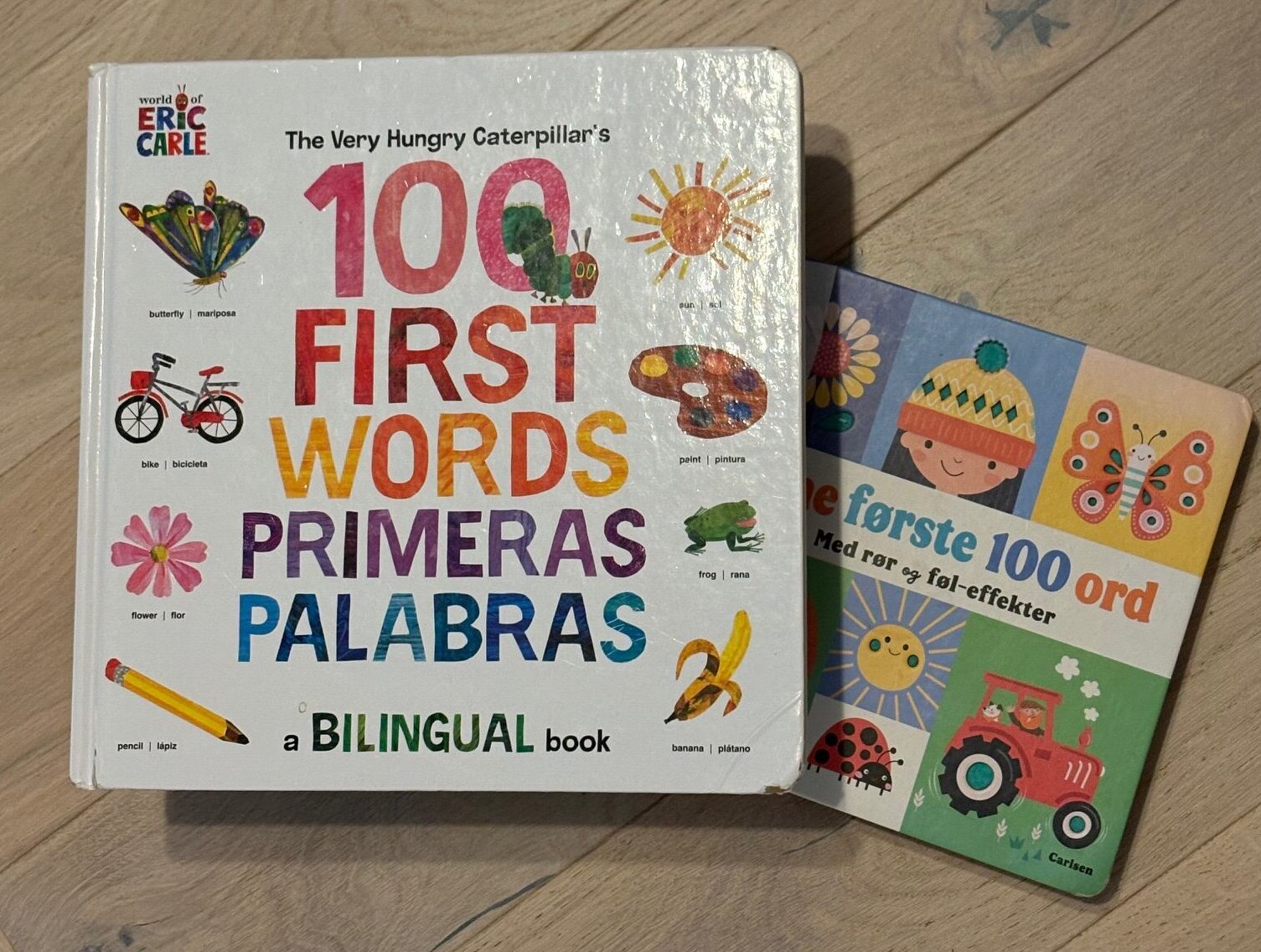
One of my favorite ways I’ve seen this play out is when we ask the twins something like “What does Papa call this?” or “What do they call this in vuggestue?” Prompted that way, for a lot of words they can actually produce all three versions — English, Spanish, and Danish — one after another. It’s not that they don’t know the word, or that the languages are jumbled together in some confused pile. They know exactly which word belongs to which person, place, and context. They might not always have the word in all 3 languages, but when they do, they have no problem identifying where it belongs.
3. Exposure is extremely important
Find as many ways as possible to talk to, read to, sing to, and otherwise engage your children in your language. My husband is really good about narrating everything he does when he’s with our children, and I think this is one of the reasons why much of their early language development was in Spanish. Even though I love to talk, I actually find this one really difficult (probably because I find it quite boring), but it absolutely does matter, so it’s important to find ways that work for you.
Our twins are talking a lot more now, so we’ve had more of a chance to really see this play out. One thing I learned when attending a seminar for parents of multilingual children at the Copenhagen Library is that up to about 3 years old is the best time to introduce a new language. After that point, their experience would be similar to how you’d feel if you were put into a room full of people speaking a language you don’t understand (and I don’t know about you, but that makes me pretty uncomfortable). So if you’re wondering if you should wait to introduce another language to your child, the answer is probably “no.”
One thing that’s made a real difference for us at this age: songs. My kids are constantly trying to sing their favorite songs, and so many toddler songs come with movements too — think “Head, Shoulders, Knees and Toes” — which reinforces what the words actually mean, not just how they sound. That particular song also happens to exist in multiple languages, which makes it an easy way to reinforce the same concept across languages without much extra effort. Songs are also just a practical form of exposure: I try to put music on in the mornings while we’re getting ready, when I’m not able to be narrating everything I’m doing out loud. My kids have picked up a surprising amount of language that way — I’ve actually caught them singing English songs I barely know myself, that they could only have learned from hearing them play.
The Bottom Line
Most days it looks like this: a sentence with a Danish verb, a Spanish noun, and an English “please” tacked on for good measure, because apparently that’s the polite one (and I guess, to be fair, there’s no Danish word for “please”). Meanwhile I’m over here still mentally rehearsing Danish sentences before I say them out loud. My kids are just going to grow up doing it without thinking twice — a kind of effortless switching a lot of people spend years working toward. That boy at pickup got a preview of something that they’ll never even register as remarkable.
FAQ: Raising Multilingual Children
Does mixing languages mean my child is confused? No — language mixing (sometimes called “code-switching”) is a completely normal part of multilingual development, not a sign of confusion. Young multilingual children often blend words or grammar from different languages in the same sentence, especially before around age 4–5. Most children naturally sort this out as their vocabulary in each language grows.
What’s the best age to start teaching a child a second or third language? The earlier, the better — ideally before around age 3, at least I have been told. Children’s brains are especially primed for language acquisition in the first few years of life. That said, it’s absolutely still possible to raise a bilingual or multilingual child starting later; it just tends to take even more deliberate effort.
What’s the best language to teach my child — the “most useful” one, or my own? In my experience, the best language to teach your child is usually the one that feels most natural to you — the one that’s closest to your heart, not necessarily the one that seems most “useful” on paper. Raising a multilingual child takes real, sustained effort, and on the hard days, it’s genuinely difficult to keep showing up in a language that doesn’t feel like you. It’s much easier to stay consistent — reading, narrating, singing, correcting yourself when you slip — in a language you actually love and feel connected to. Consistency matters more than which language you pick, so pick the one you’ll actually stick with.
Will learning multiple languages delay my child’s speech? Not overall. A multilingual child’s total vocabulary across all their languages is typically on par with a monolingual child’s — it’s just spread across more than one language. It can look like a “delay” if you only count the words in a single language, but that’s not the full picture.
How many languages can a young child realistically learn at once? There’s no fixed cap, but most families raising multilingual children successfully manage two or three, usually tied to real, consistent contexts — one language per parent, one for the community/daycare/school, and so on. The key isn’t the number of languages, it’s having a clear goal and consistent exposure for each one.