
Understanding the Danish Supermarket Hierarchy
One of the things that confused me most when I first moved to Denmark was grocery shopping.
On my very first day in the country, I walked to the nearest supermarket — a Netto just down the street from my apartment — assuming it would be like any other grocery store. Instead, I found what felt like a strangely disorganized store with a surprisingly limited selection. Products were still sitting in shipping boxes, some of the items I expected simply weren’t there, and I spent a lot of time wandering the aisles trying to figure out where anything was.
At the time, I assumed that was just what Danish supermarkets were like.
It took me a while to realize that what I had walked into wasn’t a typical supermarket at all — it was a discount chain, and Denmark has a whole ecosystem of grocery stores that fall into different “tiers.”
Once I understood that hierarchy, grocery shopping here suddenly made a lot more sense.
There used to be even more variety in the Danish grocery landscape, but some chains have disappeared or changed ownership over the years. The most recent casualty was Irma, which for many people represented the “top tier” of Danish grocery shopping. (RIP Irma.)
In the U.S., I was used to going to one large supermarket and buying everything I needed in a single trip. In Denmark, that’s not always possible. Many of the cheaper stores carry only a limited selection, so if you’re looking for something specific you may need to visit a different chain.
The Three “Tiers” of Danish Supermarkets
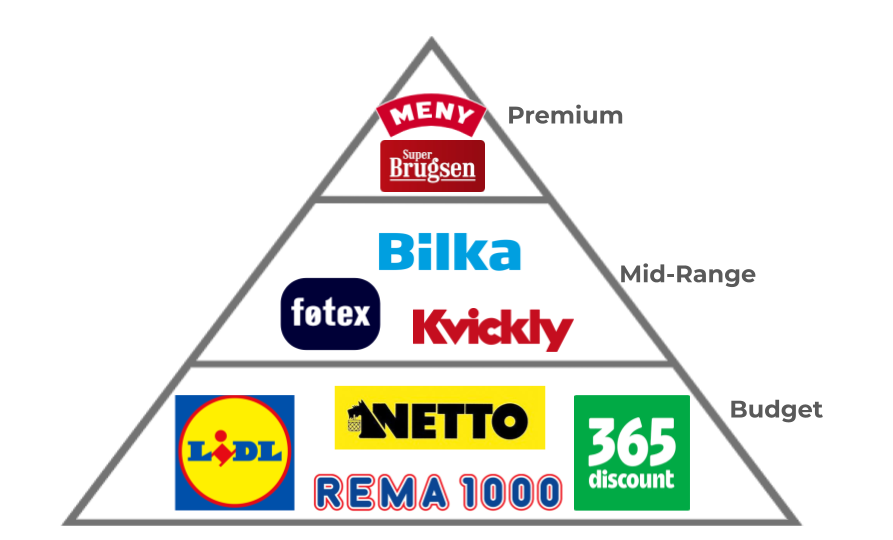
While no official classification exists, most people in Denmark informally think about supermarkets in three tiers.
Tier 3 — Budget / Discount
- Lidl
- Rema 1000
- Netto
- Coop 365
Tier 2 — Mid-range / full supermarkets
- Føtex
- Kvickly
- Bilka
Tier 1 — Upscale / specialty
- Meny
- SuperBrugsen / Brugsen
The stores in the budget tier are the cheapest but usually have the smallest selection. Mid-range stores function more like traditional supermarkets, and the top tier tends to carry more specialty and premium products.
A Helpful App for Finding Grocery Deals
One tool that many people in Denmark use is the MineTilbud app.
It collects weekly sales flyers from all the major supermarket chains and allows you to search for specific products across stores.
It’s great for figuring out things like:
- where eggs are cheapest this week
- which store has Lurpak butter on sale
- which supermarket is running a produce promotion
If you’re trying to keep grocery costs down, it can be surprisingly useful.
A Quick Guide to the Major Supermarket Chains
Netto
Netto is the classic Danish discount supermarket. It’s cheap, simple, and great for everyday basics.
You’ll often see products still sitting in the boxes they were shipped in, and the selection is fairly limited compared to larger stores. But you can usually find good prices on staple items, and the random bins of discounted products sometimes hide surprisingly good finds.
One thing I’ve learned over time is that not all Nettos are created equal. Some are small and poorly stocked, while others are much better.
Coop 365
Coop 365 is another pure discount chain. Personally, I don’t find that it stands out much compared to the others.
The main reason I go here is when they have a specific sale I’m after — for example when Lurpak butter is discounted.
Rema 1000
Rema 1000 is technically a discount supermarket, but it’s one of my personal favorites.
They have a strong store brand that tends to be both good quality and inexpensive, and their fruit and vegetable selection is often better than other discount stores.
We regularly buy things like diapers, wet wipes, kitchen paper goods, and pantry staples such as canned beans here.
Lidl
Lidl is a German chain and often carries brands and products you won’t find in other Danish supermarkets.
They also have a nice bakery section, rotating “theme weeks” featuring food from different countries, and the classic discount bins where you can occasionally discover unexpected items.
Føtex and Kvickly
To me, Føtex and Kvickly are fairly similar. They’re what I would consider true supermarkets, sitting in the middle tier.
These stores usually have:
- a wider product selection
- more branded products
- better specialty sections
They also sell non-food items like clothes, toys, and kitchen goods. In that sense they feel a bit like a small version of Target.
They’re great when you need something beyond the very basics — or when you suddenly realize you also need a pair of socks or a toy for your child.
Bilka
Bilka is the closest thing Denmark has to a Walmart-style hypermarket.
The store in Fields, for example, is enormous and carries almost everything you can imagine. Bilka also has a large online shop.
One thing I particularly recommend is their wool clothing for children, which tends to be both affordable and good quality.
SuperBrugsen and Brugsen
SuperBrugsen stores are generally larger, while Brugsen locations tend to be smaller and more local.
These stores usually carry a mix of everyday groceries and more premium products, especially when it comes to produce, meat, cheese, and wine.
Our local SuperBrugsen, for example, has a surprisingly good selection of Italian products, and we often go there for specific items like large beef tomatoes in the summer.
Meny
With Irma gone, Meny is probably the closest thing Denmark has to a true top-tier supermarket.
Regular Meny locations carry a mix of everyday groceries and higher-end products, but some stores lean heavily into specialty items.
The Meny in the basement of Magasin at Kongens Nytorv, for example, is particularly upscale — and priced accordingly.
When I lived close to a Meny, I sometimes did most of my grocery shopping there because the selection felt closest to the large supermarkets I was used to in the U.S. These days, with two kids, it would probably be quite expensive to shop there regularly.
But it’s still a great place to visit when you’re looking for special ingredients or planning something a bit more elaborate.
Grocery Delivery in Denmark: Nemlig
Another major part of the Danish grocery landscape is online grocery delivery, especially through Nemlig.com.
Nemlig is essentially a full online supermarket where you can order groceries and have them delivered directly to your home. Their selection is quite broad — closer to what you might find in a larger supermarket like Føtex or Meny — and they also carry some specialty products.
For families with young children (or anyone who doesn’t love hauling groceries home by bike), it can be incredibly convenient. Instead of visiting multiple stores to find everything you need, you can simply order it all in one place.
The main downside is price. Nemlig is generally more expensive than the discount chains, and there’s also a delivery fee depending on the time slot you choose. Still, for many people in Denmark it has become a regular part of grocery shopping.
Grocery Shopping in Denmark
Grocery shopping in Denmark is a bit different from what I was used to growing up in the U.S., where a single large supermarket usually had everything.
Here, many people end up developing a routine that combines a few different options — maybe a discount store for basics, a mid-range supermarket for broader selection, and occasionally a higher-end store for specialty items.
It felt confusing at first, especially that first day wandering around Netto wondering where everything was.
But once you understand the supermarket hierarchy, the system actually starts to make a lot more sense.