
Why Won’t My Baby Sleep? What the Advice Gets Wrong

Why won’t my baby sleep? If you’ve found yourself googling that at 2am — if your baby wakes every two hours, if you’ve tried the schedule and the wake windows and the eat-play-sleep routine and none of it has made any difference, and if everyone around you seems to have cracked something that you can’t — then this post is for you. This is the post I wish I could have read during our first, sleepless year.
We had months, not weeks, where two hours of unbroken sleep was a good night. A good night. I followed every piece of advice I could find, and most of it either didn’t help or actively made things worse. What actually helped me was understanding why we were having that experience — how it’s actually biologically normal (and how to know if there’s actually something medical going on), how what I was told about baby sleep was mostly untrue, and how much sleep actually varies from child to child (they are just tiny people, after all).
If you are short on time, you can jump straight to the Resources section, which has suggestions of people and organizations to follow if you’re in the midst of your own baby sleep crisis.
Where we are now — and why I’m writing this at all
As I sat in my children’s room tonight putting them to sleep, I reflected on how deeply easy this process is now compared to even a year ago — and don’t even get me started on the baby stage. Tonight we laid them down, I kissed them goodnight, turned off the lights, sang a lullaby a few times and waited in the dark for ten-ish minutes until I stopped hearing movement. And that was it.
Contrast that with the baby stage, where bedtime would take 20+ minutes, involve a lot of crying and screaming, and I would always — always — be sweating by the end of it. And that was multiple times a day, every nap and every bedtime, for months. The trauma I have leftover from that period is a big part of why I even started this blog in the first place, and it is absolutely what inspired me to write this post.
Talking to another mom the other day, I reflected on how my children’s horrible baby sleep is basically my motherhood origin story — it’s probably as much a reason I started this blog as being a twin mom, if not more. I told her that I relate to other moms whose babies never slept even more than I relate to other twin moms. I truly believe that everything feels hard when you haven’t slept — and when you do sleep, you feel like you can handle anything.
Recently, when I look back at pictures of my boys as babies, I feel a twinge of safness when I look at their cute little faces — not so much because they’re growing up, but because I am having so much fun being their mom now, and I wish I could have felt like this back then. Or that I could go back just for one day, to know what it would have felt like to have them at that age and be thriving. Because I can say now, with some distance, that I was just barely surviving. I was completely exhausted, and on top of that, overwhelmed from dealing with two very demanding babies all day. (Sorry, but if you think the toddler stage is harder than the baby stage with twins, you had easy babies. I will die on this hill.)
To be fair, even now I don’t really know anyone who went through this many sleep issues with twins — which is part of why I wanted to write it all down. If you’re in it right now, this is what I wish I could have read.
First: what’s actually biologically normal
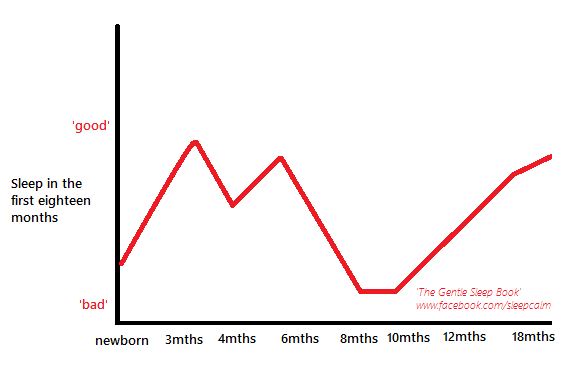
Babies wake up, and that’s not a problem to solve — it’s simply how they’re designed. On top of that baseline, there are also various points throughout the first couple of years where sleep gets noticeably worse before it gets better again — these are often called “regressions,” and they tend to line up with some kind of developmental leap. The four-month one is by far the most famous, probably because it’s usually the first one parents hit, and because there’s so much written about it. Probably also because it follows a point where babies are often sleeping the best that they will for their entire first year. I remember finding this particular graph and feeling something between relief that what I was experiencing was normal and anger that I had never been told this before — because up until that point, I had genuinely believed that something was wrong.
Understanding that the regression itself was normal turned out to be only the first piece. The second piece — and the one that took longer to really land — was realising that what comes after the regression isn’t a steady climb toward sleeping through the night either. Sleeping through the night is not the developmental milestone we’re led to believe it is, and expecting it — quietly measuring yourself against the babies who apparently do it — is a reliable way to feel like you’re failing when you’re not.
For us, that realisation really crystallised around five or six months. I remember accepting, almost with relief, that we simply weren’t going to be sleeping through the night anytime soon — and letting go of the waiting helped more than I expected it to. Honestly, we still don’t sleep through the night now. I could count on one hand the number of nights both boys have slept through completely, though one or the other manages it fairly often these days, and the wake-ups themselves are much shorter and easier than they used to be. I wish I’d known this from the start, because it would have given me a far more realistic baseline from day one. Plenty of kids are sleeping through the night by two, but it’s also completely normal for them to still wake occasionally — and that doesn’t mean anything has gone wrong.
That same idea — that “normal” covers a much wider range than we’re told — goes for where babies sleep too, not just how long. We never really did the co-sleeping thing ourselves, mostly because with twins it simply wasn’t practical in the way it might be with one baby. That said, when one of them has been sick or we’ve genuinely hit a wall at 2am and nothing else is working, we’ve ended up with one or the other in bed with us — and it’s fine, and it works, and I don’t think twice about it. If I ever had another child, I would absolutely consider it as the default option from the start. It’s biologically normal, the instinct to want your baby close at night isn’t a bad habit you’ve accidentally created, and if you want to do it, you just need to do it safely.
What our nights actually looked like
I want to be specific here, because I think vague references to “sleep deprivation” don’t really capture it and make it easy to assume your situation is an outlier when it probably isn’t.
For months — not a few rough weeks, but months in a row — we almost never slept more than two hours at a stretch. A good night, the kind we’d actually feel relieved about the next morning, was each of our boys waking up three times. That was the ceiling. Anything better than that felt like a gift. I still remember one night in Switzerland, during our road trip back from Barcelona to Copenhagen, where we said to each other “this was a really good night” and we had had 3 wake ups per child. And I still remember it almost 2 years later, if you’re wondering how often that happened.
Since we had twins, that also meant that both of us were usually “on duty” all night – because if one of us was awake with one baby and the other baby woke up, then the other one of us also had to get up. It was a big milestone for us when the wake ups decreased enough that we could reliably split the night, and an even bigger milestone when we could alternate nights. It took awhile to get there (certainly more than a year!), but it did eventually come.
How much of this is actually temperament
So why won’t your baby sleep through the night, no matter what you try? Here’s the thing I really wish someone had said out loud before I spent months second-guessing myself: you probably can’t influence your child’s sleep as much as you think you can.
The parents who swear by their sleep method — the schedule, the routine, the exact sequence of events — a lot of them just have a child who sleeps, and the method gets the credit. The parents who have tried absolutely everything and are still up four times a night? They know the truth, because they’ve lived it, and no amount of optimising the bedtime routine changes what their child’s nervous system is doing.
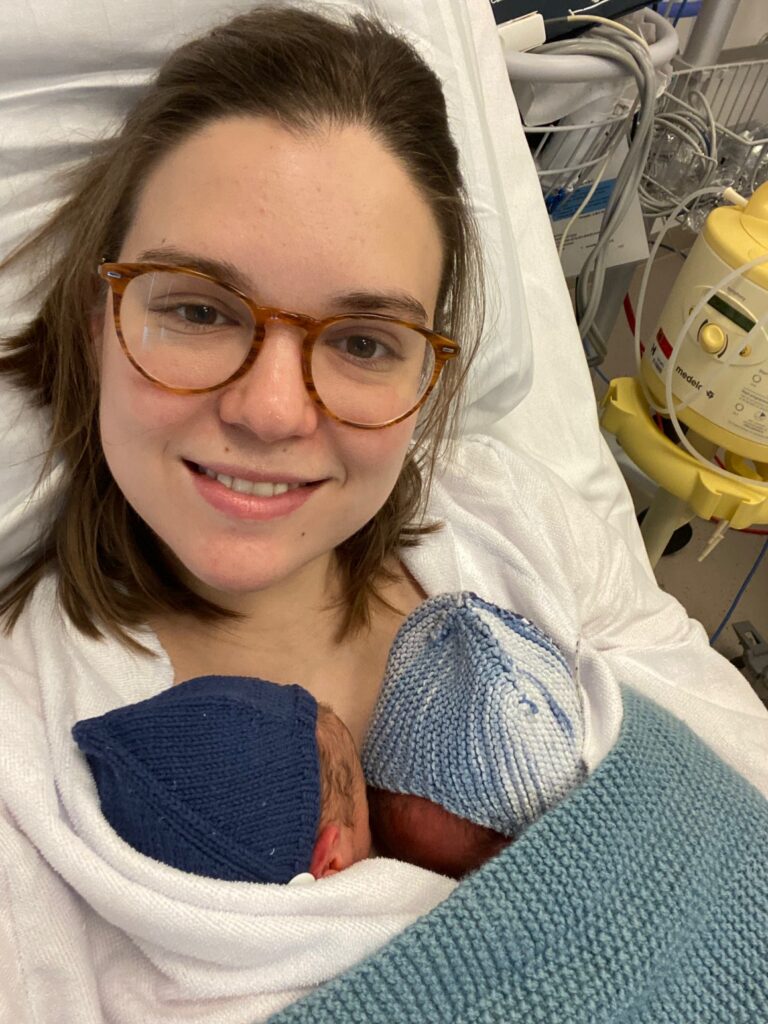
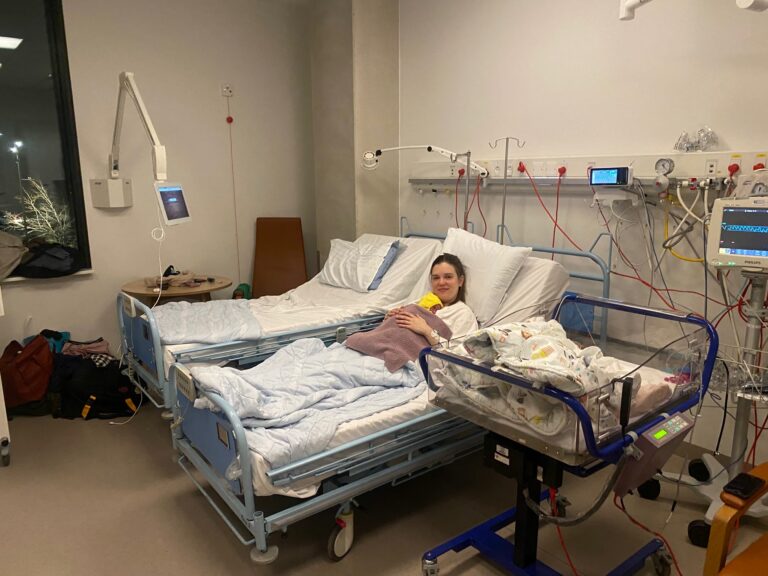
One thing I’ve reflected on a lot is whether there might be factors that make some babies more prone to sleep difficulties than others — beyond just temperament. Based on my own experience and the people around me, I’ve noticed that the babies in my circle who slept as poorly as mine were almost all boys, and almost all had also spent time in the NICU or been separated from their mothers in the first hours after birth. My boys were premature and went straight to the neonatal unit — and I can’t help wondering whether that early separation, and missing out on those first hours of skin-to-skin contact, had some lasting impact on how settled they felt at night.
It turns out there is actually some research to support this: studies have found that preterm toddlers have significantly more night wakings and lower sleep efficiency than full-term babies, and that sleep problems in children born prematurely can persist well into childhood. Research has also shown that early separation increases stress responses in newborns, while skin-to-skin contact supports brain maturation and nervous system regulation. None of this is yet fully conclusive, and every baby is different — but if you had a premature baby or a NICU stay, I think it’s worth factoring into your expectations and extending yourself a little extra grace. You may simply be starting from a harder place than most, through no fault of your own.
On schedules, wake windows, and what I’d do differently
I followed the advice — the schedules, the wake windows, the eat-play-sleep structure — and in retrospect, I think some of it probably made things worse rather than better.
The reason I turned to those frameworks is that I genuinely struggled to read the boys’ cues. I couldn’t tell when they were ready for a nap, they often cried when being put down, and having a system to follow felt like it gave me something to hold onto when everything else felt chaotic. I understand why those resources exist and why they’re so popular — when you’re that exhausted and that uncertain, a clear rule feels like relief.
But looking back, I think that by trying to fit them into an external schedule rather than following their actual daily rhythm, I was probably getting the balance of awake time wrong in a way that affected their night sleep too. Thinking back on the nights they slept better and also what causes them to sleep better now, there was definitely something about awake time in the evenings being longer, as well as getting lots of stimulation and physical activity in during the day (not exactly easy when you’re alone all day with twins).
The eat-play-sleep thing is also something I’d let go of entirely if I were doing it again. I tried hard not to use breastfeeding as a sleep prop because everything I read said I shouldn’t — the logic being that whatever gets them to sleep will be what they need to get back to sleep, so you’re essentially building a problem for yourself. I wish I’d ignored all of that. Because here’s what actually happened: despite not being fed to sleep at bedtime, the boys needed to be fed back to sleep at night until we fully night weaned them at 13 months. At 18 months, they did eventually start falling asleep on their own – and yet they still woke up at night and needed help getting back to sleep. The sleep associations argument just didn’t hold — falling asleep independently at the start of the night and staying asleep through the night turned out to be two completely separate things, and conflating them had made the early months harder than they needed to be. If the boob (or the bottle) works, use the boob. It’s not a trap. It’s a tool you have access to for a limited time, and there will come a point when it’s no longer needed, potentially without you having done anything in particular to engineer that.
On sleep training
I’m not going to tell you what to do, because you’re sleep deprived, you need to function, and the stakes feel impossibly high in a way that’s hard to explain to anyone who hasn’t been there. But I do think there’s something important that gets lost in the sleep training conversation, which is that every baby is genuinely different — and what works beautifully for one child may be completely wrong for another.
I have a friend who used Ferber on her baby and it worked, but only temporarily. I have another whose baby would settle himself after five or ten minutes of crying, reliably, every time — and for them it was genuinely fine. My kids? They would have screamed, instantly and indefinitely, and I honestly doubt Ferber would have worked at all. I’ve read stories of parents whose babies have cried for hours with no decrease, night after night, and it becomes pretty clear at some point that this approach just isn’t going to work for that particular child. So maybe sleep training is genuinely fine and not particularly traumatic for some babies — but for others it’s simply not the right fit, and no amount of persistence is going to change that.
What I will say is that I very seriously considered it, and I’m glad we didn’t go down that road, for reasons that only became fully clear much later. Along our journey, we found medical reasons for why the boys weren’t sleeping well at night — enlarged adenoids, reflux, and gas, to name a few. I don’t know for certain whether those were factors during their first year, but they could have been. If I had left them to cry through that, I would have been leaving my children with genuine, unmet physical needs to manage alone in the dark, and I find it hard to make peace with that hypothetical.
That’s the part that has always given me pause about cry-it-out: the assumption that you can always verify your baby’s needs are met before you leave them. Sometimes the reason they’re crying isn’t visible — it might be something medical, something you haven’t identified yet, or just something that doesn’t sit right with you as a parent. And I think that instinct matters. If you genuinely feel your child is okay, then trust that. But if something feels off, or it’s not working, or you just can’t shake the doubt — that’s worth listening to too. You know your child better than any sleep book does.
The bigger lesson I took from all of this — and I really wish I’d known it sooner — is simply that if something isn’t working, it’s okay to stop and accept that. If it’s going that badly, it’s probably not going to magically click the next day. Either it’s never going to work for your child, or they’re just not ready yet, and both of those are valid reasons to put it down and try again later — or not at all.
The best example I have of this from our own experience is following the advice of using the 5 S’s to calm them, but to put them down while they were still awake. The method itself is genuinely good — it works to calm babies down, and I used it constantly. But since I was also trying to follow the advice of putting them down drowsy but awake, which meant I’d put them in their crib before they were fully asleep, every time I put them down they’d just start crying again. Looking back, I should have just used the 5 S’s to get them all the way to sleep and not worried at all about whether they were awake when they went into the crib. Instead I kept thinking I was doing it wrong, that eventually it would click, that I just needed to be more consistent. It did eventually work — but much, much later, when they were actually ready for it. And in the meantime I made a lot of hard nights harder by persisting with something that just wasn’t working yet rather than giving myself permission to stop.
If any of the above resonates with you and you’re looking for a different type of support, check out the Beyond Sleep Training Project links in the Resources section at the end of this post.
What to check if nothing is working
Before assuming a sleep problem is purely behavioural, it’s worth taking some time to rule out the physical — because some of the most common culprits are also the easiest to overlook. Reflux, enlarged adenoids, allergies, and sensitivities are all worth investigating, and the Beyond Sleep Training Project has resources that can help you work through the possibilities systematically rather than just guessing.
In our case, we found out about the adenoids almost by accident. The boys had been sick and sleeping on me on the couch for a few nights — it was the only way anyone was getting any rest — and I happened to be awake when I heard one of them stop breathing. That sent us to the ENT, where they confirmed enlarged adenoids.
Looking back, the signs had been there for a while: the constant waking, the restless sleep, and the way they’d tilt their heads back to sleep — which, it turns out, is often an instinctive way kids try to open their airway when something’s blocking it. At the time, none of that registered as anything other than “this is just how our kids sleep.”
What’s been interesting since is that it seems to be specifically tied to being sick. The ENT didn’t see enlarged adenoids when the boys were well — only when they had a cold. Sleep has been genuinely fine all summer, and we’re now just waiting to see whether that holds through winter, or whether it comes back as soon as they’re sick again.
If any of this sounds familiar — restless sleep, head-tilting, or pauses in breathing — it’s worth raising with your pediatrician or an ENT. A few other common medical causes of sleep disruptions that are worth ruling out as well: fluid in the ears, reflux, low iron levels, and food allergies. None of these are necessarily obvious from the outside, which is exactly why they’re so easy to miss — but they’re also relatively simple to check for, and worth asking about if your child’s sleep has been consistently rough despite everything else you’ve tried.
What I actually wish I’d known
Honestly, it comes down to expectations — specifically, having different ones. I wish I’d understood earlier what was biologically normal versus what was aspirational, and what was genuinely within my control versus what was always going to be determined by the particular children I had. That shift in framing wouldn’t have made the hard nights easier, exactly, but it might have meant I spent less time trying to “fix” something that wasn’t actually broken.
If you also have a baby (or two) that doesn’t sleep, what I can say is that, barring any unresolved medical issues, it will get better with time. It won’t be easy, but you will make it through and you will absolutely be stronger on the other side. And hey, once you’ve experienced extreme sleep deprevation (literally used as torture!), what challenge is your kid possibly going to throw at you that is harder than that? The rest of this parenting thing will be a piece of cake.
Resources
Here are some of the resources I link to above, as well as some extra ones that I have found really useful when struggling with sleep.
- The Roller Coaster of Baby Sleep (start here if you have a baby that doesn’t sleep)
- Safe Sleep 7
- Beyond Sleep Training Project
- How to tell if your baby’s sleep isn’t normal (and maybe something medical is going on)
- “Articles to read when” (information for every situation)
- Facebook group (great for when you need tailored advice or just some commiseration)
- Tired Baby Sleep on Instagram (responsive sleep consultant and gives free advice on her page)